

Table of Contents
Artificial intelligence (AI) is changing the way businesses plan marketing campaigns, create content, understand customers, and generate leads. Tasks that once required hours of manual work can now be completed more efficiently with the help of AI-powered tools. From writing blog outlines to predicting customer behaviour and answering customer queries through chatbots, AI has become an important part of modern digital marketing.
However, AI is not a single technology. Different types of AI perform different functions, and understanding these differences helps marketers choose the right tools for their goals.
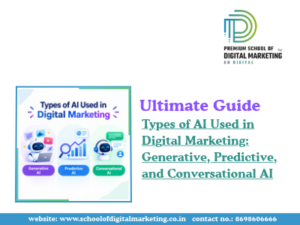
The three important types of AI used in digital marketing are generative AI, predictive AI, and conversational AI. Generative AI creates content, predictive AI analyses data to forecast likely outcomes, and conversational AI helps businesses communicate with customers through natural language.
In this guide, we will explore how these three types of AI work, their applications in digital marketing, their benefits and limitations, and how aspiring marketers can develop the skills needed to use them effectively.
What are the Types of AI Used in Digital Marketing?
The three major types of AI commonly used in digital marketing are generative AI, predictive AI, and conversational AI. Each serves a different purpose, from content creation to data analysis and customer engagement.
Here is a quick comparison:
| Type of AI | Main purpose | Digital marketing examples |
|---|---|---|
| Generative AI | Creates new content and ideas | Blog drafts, ad copy, images, email content |
| Predictive AI | Estimates future outcomes using data | Lead scoring, conversion forecasting, customer churn prediction |
| Conversational AI | Understands and responds to customer queries | Website chatbots, virtual assistants, automated customer support |
Businesses can use these technologies individually or combine them to build more efficient marketing workflows.
For example, a digital marketing team can use generative AI to create an advertising campaign, predictive AI to identify promising audience segments, and conversational AI to answer questions from potential customers.

1. Generative AI in Digital Marketing
Generative AI is a type of artificial intelligence that produces new content based on instructions, examples, and patterns learned during training. Depending on the tool, it can generate text, images, audio, video, and other forms of content.
Popular examples include ChatGPT, Google Gemini, Claude, and AI-powered image-generation tools.
How is generative AI used in digital marketing?
1. Content creation
Content marketers can use generative AI to develop blog outlines, draft articles, create social media captions, write product descriptions, and brainstorm content ideas.
For example, a marketer promoting a digital marketing course can use an AI tool to generate blog topic ideas around SEO, social media marketing, Google Ads, and career opportunities. The marketer can then research the subject, verify facts, add relevant examples, and edit the content before publishing.
2. SEO content optimization
Generative AI can assist with keyword research workflows, search-intent analysis, title suggestions, meta descriptions, FAQ ideas, and content outlines.
However, AI-generated content does not automatically rank well on Google. Content still needs to be accurate, useful, original in its insights, and relevant to the audience’s needs.
3. Social media marketing
Social media professionals can use generative AI to create caption variations, campaign ideas, content calendars, reel scripts, and platform-specific posts.
A single blog post, for instance, can be repurposed into a LinkedIn post, an Instagram carousel script, a short-video concept, and an email newsletter.
4. Advertising and copywriting
Generative AI can suggest multiple versions of headlines, calls to action, ad descriptions, and landing-page copy. Marketers can test these variations to identify which messages perform best.
5. Email marketing
AI can help draft promotional emails, subject lines, product announcements, and follow-up messages. Marketers should review the content to ensure it matches the brand voice and does not make misleading claims.
Benefits of generative AI
- Speeds up content ideation and first-draft creation.
- Helps marketers explore different creative approaches.
- Supports content repurposing across multiple channels.
- Makes it easier to produce variations for testing.
- Can reduce repetitive work when used with human review.
Limitations of generative AI
Generative AI can produce incorrect facts, generic content, biased outputs, or information that sounds convincing but is not verified. It may also create content that lacks genuine experience or a brand’s unique perspective.
Best practice: Use generative AI as an assistant rather than an automatic replacement for research, subject expertise, editing, and creative judgment.
2. Predictive AI in Digital Marketing
Predictive AI uses historical data, statistical methods, and machine learning models to estimate what may happen in the future.
Unlike generative AI, which focuses on producing content, predictive AI focuses on identifying patterns and forecasting likely outcomes.
For digital marketers, this can mean estimating which customers are more likely to purchase, which leads deserve attention, or which customers may stop engaging with a business.
How is predictive AI used in digital marketing?
1. Lead scoring and qualification
Predictive models can analyse historical lead data, such as website interactions, previous enquiries, engagement patterns, and past conversions, to estimate which new leads are more likely to become customers.
For example, an education company may use a predictive model to prioritise enquiries from people who have viewed course pages, attended a demo session, and requested fee details.
The model’s accuracy depends on the quality and relevance of the available data.
2. Customer behaviour prediction
Predictive AI can help businesses identify purchasing patterns, estimate repeat-purchase likelihood, and understand which customer segments may respond to particular offers.
These insights can help marketers plan more relevant campaigns.
3. Conversion forecasting
Businesses can use predictive models to estimate potential conversions based on historical campaign performance and other relevant signals. Such forecasts help with planning, although actual results can differ because market conditions and customer behaviour change.
4. Customer churn prediction
Customer churn refers to customers who stop using a service or buying from a business.
Predictive AI can identify patterns associated with customers who are likely to leave. Businesses can then investigate the reasons and consider appropriate retention campaigns.
5. Marketing budget allocation
Predictive analytics can support decisions about campaign spending by estimating the likely outcomes of different strategies. Marketers should combine these estimates with actual campaign performance, costs, and business objectives before reallocating budgets.
Benefits of predictive AI
- Helps prioritise leads and customer segments.
- Supports data-driven marketing decisions.
- Improves forecasting and campaign planning.
- Can help identify potential customer retention issues.
- Enables more focused use of marketing resources.
Limitations of predictive AI
Predictive AI depends on reliable data. Incomplete records, outdated customer information, biased historical data, and changing market conditions can affect its predictions.
It also identifies probabilities rather than certainties. A lead predicted to convert may not purchase, while a lead assigned a lower score may still become a valuable customer.
Best practice: Treat predictive insights as decision-support tools. Review model performance regularly and use human judgment before making important marketing decisions.
3. Conversational AI in Digital Marketing
Conversational AI enables software to understand and respond to human language through text or voice. It is commonly used in chatbots, virtual assistants, customer support systems, and automated messaging workflows.
Modern conversational AI can use natural language processing and large language models to interpret questions, maintain context, and generate relevant responses.
How is conversational AI used in digital marketing?
1. Website chatbots
AI-powered chatbots can answer frequently asked questions about products, services, pricing, delivery, and other topics. They can also direct visitors to relevant website pages.
For example, a visitor exploring a digital marketing training website may ask about course modules, available batches, or classroom and online learning options. A chatbot can provide approved information and guide the visitor to the appropriate enquiry form.
2. Lead generation
Conversational AI can collect basic information from interested visitors, such as their preferred course, location, or learning format.
With appropriate consent and integrations, the information can be passed to a CRM or sales team for follow-up.
3. Customer support
Businesses can use conversational AI to handle routine questions around the clock. More complex requests should be transferred to a human representative when necessary.
4. WhatsApp and messaging automation
AI-enabled messaging systems can help businesses respond to enquiries, share relevant information, and support customer journeys through messaging channels. Businesses must follow applicable platform rules and consent requirements.
5. Personalised customer interactions
Conversational AI can tailor responses according to the user’s question and available context. For instance, an online retailer’s assistant may provide different product recommendations based on a customer’s stated needs.
Personalisation should be based on appropriate data use, with safeguards for privacy and accuracy.
Benefits of conversational AI
- Enables quicker responses to routine enquiries.
- Supports customer engagement beyond standard business hours.
- Helps capture and organise leads.
- Reduces repetitive support tasks.
- Can guide customers towards relevant products, services, or resources.
Limitations of conversational AI
Chatbots can misunderstand questions, provide incorrect answers, or struggle with unusual situations. They may also frustrate users if they cannot connect them to a human when needed.
Best practice: Train the system on reliable information, monitor conversations, protect customer data, and provide a clear option to contact a human representative.
Generative AI vs Predictive AI vs Conversational AI
Although these technologies can work together, their primary functions are different.
| Comparison | Generative AI | Predictive AI | Conversational AI |
|---|---|---|---|
| Main goal | Create content | Forecast likely outcomes | Communicate with users |
| Typical input | Prompts and context | Historical and current data | Questions and conversation context |
| Typical output | Text, images, ideas | Scores, probabilities, forecasts | Responses and conversation flows |
| Marketing use | Content and creative development | Lead scoring and forecasting | Chatbots and customer support |
| Example | Drafting an ad headline | Estimating lead conversion likelihood | Answering a course enquiry |
These categories can overlap. A conversational assistant may use a generative model to produce responses, while a marketing platform may combine predictive models with generative AI to recommend campaign actions.
The best choice depends on the marketing problem a business wants to solve.
Real-World Example: How a Business Can Combine All Three Types of AI
Consider a digital marketing institute that wants to increase course enquiries and improve its lead-to-enrolment process.
It could use all three types of AI at different stages of the customer journey.
Step 1: Generative AI for awareness
The marketing team creates blog outlines, social media content, email drafts, and advertising copy to explain the benefits of its courses.
Step 2: Predictive AI for lead prioritisation
The team analyses relevant historical lead and enrolment data to identify patterns associated with successful enrolments. A predictive model helps prioritise leads for follow-up.
Step 3: Conversational AI for enquiries
A website chatbot answers common questions about course topics, batch schedules, and learning formats using verified information.
Step 4: Human follow-up and measurement
The admissions team handles detailed counselling, confirms course suitability, and follows up with interested prospects. The marketing team measures enquiry quality, enrolments, and campaign costs to assess performance.
This approach illustrates how AI can support the marketing funnel, from awareness and engagement to lead qualification and conversion. The results will depend on the quality of implementation, data, content, and human follow-up.
Check out our latest blogs On: How to Repurpose One Blog into Social Media Posts, Reels, and Emails
How to Choose the Right Type of AI for Your Digital Marketing Goals
Before investing in AI tools, identify the specific task you want to improve.
| Marketing goal | Suitable AI type | Example application |
|---|---|---|
| Create content faster | Generative AI | Blog drafts and social media captions |
| Identify promising leads | Predictive AI | Lead scoring |
| Answer customer questions | Conversational AI | Website chatbot |
| Improve campaign planning | Predictive AI | Conversion forecasting |
| Generate ad variations | Generative AI | Headlines and creative concepts |
| Automate routine enquiries | Conversational AI | Customer support assistant |
Businesses do not need to adopt every AI technology at once. Starting with one clearly defined problem makes it easier to measure whether the investment is worthwhile.
For example, a small business could begin with generative AI for content planning, introduce a chatbot to handle frequent enquiries, and consider predictive analytics once it has enough reliable data.

Challenges and Ethical Considerations of AI in Digital Marketing
AI can make marketing workflows more efficient, but it also introduces responsibilities that businesses should not overlook.
Data privacy: Customer information must be collected and used appropriately. Businesses should understand the privacy policies and data-handling practices of the tools they use.
Accuracy: AI-generated content and chatbot responses require fact-checking, especially when discussing pricing, financial matters, health-related products, or contractual terms.
Bias and fairness: Predictive models can reproduce biases present in historical data. Businesses should evaluate whether their systems disadvantage particular customer groups.
Transparency: Customers should not be misled into believing they are communicating with a human when they are interacting with an AI assistant.
Human oversight: AI should support marketing decisions rather than remove accountability. Human professionals remain responsible for reviewing outputs, interpreting results, and protecting customer trust.
Measurement: AI adoption should be evaluated using meaningful business outcomes, such as qualified leads, conversion rates, customer satisfaction, time saved, and return on investment.
Why Digital Marketers Need AI Skills
AI tools are becoming increasingly useful across SEO, content marketing, social media, paid advertising, email marketing, and analytics. However, knowing how to open an AI tool is not the same as knowing how to use it effectively.
Digital marketers need to understand how to write clear prompts, verify information, interpret data, maintain brand consistency, and connect AI-generated outputs with business goals.
They should also understand traditional marketing fundamentals, including audience research, keyword strategy, campaign planning, conversion optimisation, and performance measurement.
For learners who want structured practical training, choosing the right institute can be a useful step. Those exploring a digital marketing institute in Pune can compare course modules, practical assignments, trainer experience, and placement support. Similarly, learners researching a digital marketing institute in Mumbai, a digital marketing institute in Nashik, or a digital marketing institute in Nagpur should evaluate the curriculum and hands-on learning opportunities before enrolling.
When comparing a digital marketing course in Pune, a digital marketing course in Mumbai, a digital marketing course in Nashik, or a digital marketing course in Nagpur, look for a programme that covers SEO, social media, paid advertising, analytics, and practical AI applications rather than focusing only on individual tools.
A good learning programme should help students understand when to use AI, when to rely on human expertise, and how to evaluate whether a marketing activity is delivering meaningful results.
The Future of AI in Digital Marketing
AI is likely to become more deeply integrated into marketing platforms, customer relationship management systems, content workflows, advertising tools, and analytics solutions.
Generative AI may make content development more flexible, predictive AI may support better-informed planning, and conversational AI may enable more natural customer interactions.
At the same time, originality, trust, data quality, privacy, and human expertise will remain important. Businesses that combine useful AI applications with sound marketing strategy are better positioned to make informed decisions than those that adopt tools without a clear purpose.
The goal is not to automate every marketing task. It is to identify where AI can improve efficiency, customer experience, and decision-making while preserving human judgment.
Conclusion
Generative AI, predictive AI, and conversational AI serve different but complementary roles in digital marketing. Generative AI helps create content, predictive AI estimates likely outcomes from data, and conversational AI supports customer interactions.
When used responsibly, these technologies can help businesses streamline workflows, understand audiences, improve lead management, and deliver more relevant experiences.
For digital marketers, the most valuable skill is not simply using AI tools. It is knowing how to select the right technology, verify its output, interpret its insights, and connect it to measurable marketing objectives.
As AI continues to evolve, combining technical understanding with creativity, analytical thinking, and customer-focused strategy will remain essential for successful digital marketing.
Want to Make Your Brand More Visible in AI-Powered Search?
Book Your Free Demo Session and learn practical strategies to improve your brand’s visibility across ChatGPT, Google AI Overviews, and other AI-powered search platforms.
Frequently Asked Questions (FAQs)
1. What are the three main types of AI used in digital marketing?
The three commonly discussed types are generative AI, predictive AI, and conversational AI. Generative AI creates content, predictive AI forecasts likely outcomes using data, and conversational AI enables interactions between businesses and customers.
2. What is generative AI in digital marketing?
Generative AI is technology that produces content such as text, images, headlines, email drafts, and social media captions. Marketers use it to support content creation, brainstorming, and campaign development.
3. What is predictive AI in digital marketing?
Predictive AI analyses historical and relevant current data to estimate future outcomes. Common applications include lead scoring, customer churn prediction, conversion forecasting, and customer segmentation.
4. What is conversational AI, and how is it used in marketing?
Conversational AI enables software to understand and respond to human language. Businesses use it in website chatbots, virtual assistants, and messaging systems to answer enquiries, support lead generation, and handle routine customer questions.
5. What is the difference between generative AI and predictive AI?
Generative AI primarily produces new content, while predictive AI estimates likely outcomes based on data. For example, generative AI can draft an advertisement, whereas predictive AI can estimate which customer segment may be more likely to respond.
6. Can AI replace digital marketing professionals?
AI can automate or assist with specific tasks, but it does not eliminate the need for marketing strategy, creativity, critical thinking, data interpretation, and customer understanding. Digital marketers who learn to use AI responsibly can apply it as part of a broader skill set.
7. Which AI tools can digital marketers use?
Depending on the task, marketers may use ChatGPT, Google Gemini, and Claude for content assistance; predictive analytics and CRM platforms for lead scoring and forecasting; and chatbot or conversational AI platforms for customer engagement. Tool selection should depend on the use case, cost, integrations, privacy requirements, and accuracy.
8. Is AI-generated content good for SEO?
AI-generated content can support SEO when it is accurate, useful, relevant, and created to help readers. Using AI does not automatically improve rankings. Content should be fact-checked, edited, and enriched with original insights and relevant expertise.
9. How can beginners learn AI for digital marketing?
Beginners can start by learning digital marketing fundamentals and practising with AI tools for content planning, keyword research, social media, advertising, and analytics. Hands-on projects, prompt-writing practice, fact-checking, and performance measurement help develop practical skills.
10. How do I choose a digital marketing course that teaches AI?
Compare the curriculum, practical assignments, trainer experience, live projects, analytics coverage, and career support. If AI is included, check whether the course teaches real marketing applications and responsible use rather than only demonstrating tools.