
Table of Contents
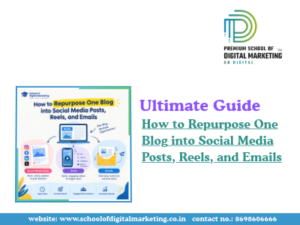
Creating fresh content for every marketing platform can be time-consuming. What if one well-written blog could provide content ideas for Instagram posts, LinkedIn updates, short-form videos, email newsletters, and more?
That is exactly what content repurposing makes possible.
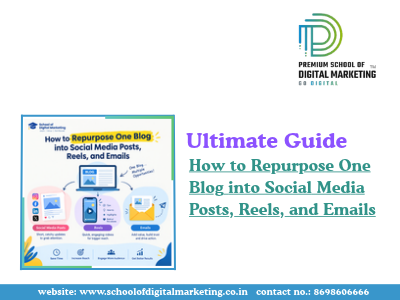
For businesses, creators, and digital marketers, learning how to repurpose one blog into social media posts, Reels, and emails is a practical way to maintain consistency, reach different audiences, and get more value from existing content. Instead of starting from scratch every day, you can turn one useful article into multiple pieces of content tailored to different platforms.
Content repurposing is an important skill because it connects content marketing, SEO, social media management, email marketing, and performance analysis.
In this guide, you will learn how to build a simple content repurposing workflow, choose the right formats, and measure the results.
What is Content Repurposing?
Content repurposing is the process of transforming existing content into different formats for different platforms and audiences.
For example, a blog titled “10 Ways to Improve Your Website Traffic” could become:
- An Instagram carousel explaining five practical traffic tips.
- An Instagram Reel sharing three quick SEO improvements.
- A LinkedIn post discussing common website traffic mistakes.
- An email newsletter summarising the most useful recommendations.
- A series of short posts answering individual questions from the article.
The goal is not to copy and paste the same content everywhere. It is to present the original information in a format that suits each platform.
In simple terms, one blog can become a complete content campaign when its key ideas are adapted thoughtfully for different channels.
Why Should You Repurpose a Blog into Multiple Content Formats?
Content repurposing helps marketers work more efficiently without compromising the usefulness of their content.
1. Save time and effort
Writing a detailed blog requires research, planning, and editing. Once the article is ready, its main ideas can provide a foundation for several social media posts, videos, and emails.
This reduces the pressure to generate completely new ideas every day.
2. Reach different audiences
Not everyone prefers reading long-form articles. Some people enjoy watching short videos, while others prefer visual summaries or email newsletters.
Repurposing allows you to communicate the same core message through different formats.
3. Extend the life of your content
A blog published several months ago may still contain useful information. Turning its key insights into fresh content can help you bring that information to new audiences.
Always review older articles first to ensure their facts, examples, statistics, and recommendations remain accurate.
4. Support SEO, AEO, and GEO
A well-structured blog can attract organic search traffic. Its concise explanations can also help answer specific questions, while relevant, clearly presented information can make the content easier for AI-powered search systems to interpret and potentially reference.
- SEO (Search Engine Optimization): Helps improve discoverability in traditional search engines.
- AEO (Answer Engine Optimization): Focuses on providing clear, direct answers to user questions.
- GEO (Generative Engine Optimization): Focuses on making useful, credible content easier for generative AI search and answer systems to understand and potentially cite.
Repurposing supports these efforts by distributing your expertise across relevant channels. However, publishing more formats does not automatically improve rankings or guarantee AI citations.
Check out our latest blogs On: How to Use AI for LinkedIn Marketing and Personal Branding
How to Repurpose One Blog into Social Media Posts, Reels, and Emails
Follow this step-by-step process to turn a single blog into a practical content distribution plan.
Step 1: Choose the Right Blog
Start with an article that contains useful, relevant information for your target audience.
Good candidates include:
- Educational how-to guides.
- Industry trend articles.
- Frequently asked questions.
- Step-by-step tutorials.
- Case studies and original research.
- Articles that already attract organic traffic or engagement.
For example, a digital marketing training institute could select a blog about “How to Improve Instagram Engagement” because it offers multiple tips that can be presented individually across social platforms.
Before repurposing, check the article’s performance in Google Search Console and Google Analytics 4, where available. Look at relevant search queries, organic traffic, engagement, and conversions to identify the topics worth extending.
Step 2: Break the Blog into Smaller Content Ideas
Read the article and identify its main takeaways, examples, statistics, questions, and actionable recommendations.
Suppose your blog contains ten tips for improving website traffic. You could divide it into the following content ideas:
- A carousel highlighting five traffic-building strategies.
- A Reel explaining one common SEO mistake.
- A LinkedIn post about why traffic quality matters.
- An email sharing three actionable recommendations.
- A short FAQ post answering a common website traffic question.
Create a simple content bank with the original blog URL, key takeaway, target audience, content format, platform, and call to action.
This makes planning easier and helps prevent repetitive posts.
Step 3: Turn the Blog into Social Media Posts
Social media posts work best when they communicate one clear idea rather than trying to summarise an entire article.
Instagram carousel: Convert a list, process, or comparison into a series of slides. Start with a strong hook, explain one idea per slide, and finish with a useful takeaway or CTA.
Example hook: “5 Simple Ways to Improve Your Website Traffic.”
LinkedIn post: Focus on professional insights, lessons learned, business implications, or practical recommendations. Use a conversational opening and short paragraphs.
Example: “Publishing more blogs is not always the answer to low website traffic. Sometimes, updating and distributing your best existing content can be a smarter starting point.”
Facebook post: Share an approachable summary, ask a relevant question, or highlight a practical tip that encourages discussion.
X post: Extract one concise insight, a useful statistic that has been verified, or a short sequence of tips. Keep the message within the platform’s current character limits.
Adapt the wording, visuals, and CTA to each platform instead of posting identical copy everywhere.
Step 4: Convert the Blog into Reels and Short Videos
Short-form videos can introduce your blog’s most useful ideas to people who prefer watching rather than reading.
You do not need to turn the entire article into a long video. Select one idea and explain it clearly.
A simple Reel structure is:
- Hook: Grab attention in the opening seconds.
- Value: Explain one problem, tip, or solution.
- Example: Demonstrate how the tip works.
- CTA: Invite viewers to read the full blog, save the video, or explore a related resource.
For example:
Reel topic: “3 Ways to Repurpose One Blog”
- Opening: “Writing a new social media post every day? Your existing blogs may already have the content you need.”
- Tip 1: Turn the main takeaways into an Instagram carousel.
- Tip 2: Explain one key idea in a short Reel.
- Tip 3: Share the article’s most useful recommendations in an email.
- Closing: “Save this workflow for your next content planning session.”
Use captions or subtitles, readable on-screen text, relevant visuals, and a suitable vertical format. Keep the video focused on one main message.
Step 5: Turn the Blog into an Email Newsletter
Email marketing helps you share useful information directly with subscribers who have chosen to hear from your business.
Instead of copying the full article into an email, summarise its most valuable points and give readers a reason to visit the original blog.
A simple newsletter structure includes:
- Subject line: Clearly communicate the benefit.
- Opening: Identify a problem or opportunity.
- Main content: Share two or three useful insights.
- CTA: Link to the full article or a relevant resource.
- Closing: Invite readers to reply or explore another useful page.
Example subject line: “One Blog, Five Content Ideas: Work Smarter with Content Repurposing”
Example email opening:
“Creating fresh content for every platform can take hours. The good news is that one helpful blog can provide ideas for social posts, short videos, and newsletters. In our latest guide, we explain how to break an article into smaller content pieces and adapt each one to its platform.”
Add a clear link to the original article, use a mobile-friendly layout, and send emails only to appropriately subscribed recipients.
Step 6: Optimise Each Format for SEO, AEO, and GEO
Content repurposing is most effective when every format has a clear purpose.
For SEO:
- Keep the original blog focused on a clear search intent.
- Use descriptive headings and relevant internal links.
- Optimise the title, meta description, images, and page experience.
- Link from relevant social posts or newsletters to the original article where appropriate.
For AEO:
- Answer the main question near the beginning of the article.
- Use descriptive H2 and H3 headings.
- Include specific, useful FAQs.
- Explain processes in clear steps and define important terms.
For GEO:
- Provide accurate, specific, and well-supported explanations.
- Include relevant examples and original insights.
- Attribute claims and statistics to credible sources.
- Make the author, organisation, and relevant expertise clear.
- Keep important information easy to identify and understand.
Social posts and emails can help distribute your expertise, but they do not replace a strong, accessible website article. There is also no guaranteed formula for being featured in AI-generated answers.
Step 7: Add Internal Links and Clear Calls to Action
Every content format should guide interested users towards a relevant next step.
For example:
- An Instagram carousel can direct users to the full blog through an appropriate profile link.
- A Reel can invite viewers to read the complete guide.
- A LinkedIn post can link to a relevant article or resource.
- An email newsletter can direct subscribers to the original blog or a related course page.
On your website, connect the article to related blog posts, relevant course pages, and useful resources. Use descriptive anchor text that tells readers what they can expect after clicking.
Avoid adding unrelated links simply to increase the number of internal links.
Step 8: Measure Performance and Improve
Publishing content is only one part of the process. Reviewing results helps you decide what to repurpose next.
Track metrics that match each channel’s purpose:
- Blog: Organic clicks, impressions, search queries, engagement, and conversions.
- Social media: Reach, saves, shares, comments, video watch time, and profile visits.
- Email: Click-through rate, conversions, unsubscribes, and other relevant engagement measures.
- Business outcomes: Qualified enquiries, registrations, demo bookings, or sales.
Use Google Search Console for search performance, Google Analytics 4 for website activity, native social analytics for platform engagement, and your email platform’s reporting for newsletter results.
Compare performance over time rather than judging a format from one post alone. Use what you learn to refine future content.
Example: Turn One Blog into a Seven-Day Content Plan
Let’s use the article “How to Improve Website Traffic” as an example.
| Day | Content format | Content idea | Goal |
|---|---|---|---|
| Monday | Blog | Publish the detailed guide | Organic discovery |
| Tuesday | Instagram carousel | Five practical traffic tips | Saves and shares |
| Wednesday | Instagram Reel | One common SEO mistake | Reach and awareness |
| Thursday | LinkedIn post | Why traffic quality matters | Professional engagement |
| Friday | Facebook post | A practical traffic-building tip | Discussion |
| Saturday | Email newsletter | Three lessons from the blog | Blog visits |
| Sunday | Short FAQ post | Answer one common traffic question | Helpful engagement |
This is an example, not a mandatory posting schedule. Choose a frequency that suits your resources and audience, and avoid publishing merely to fill a calendar.
Want to Learn How AI Can Recommend Your Brand?
Join our Free Demo Session and discover practical strategies to improve your brand’s visibility across ChatGPT and AI-powered search.
Common Content Repurposing Mistakes to Avoid
Even a good blog can lose its value when it is repurposed without a clear strategy.
Copying identical content everywhere: Different platforms have different audiences and content expectations. Adapt the message and presentation.
Trying to communicate everything in one post: Focus each post or video on a single useful idea.
Using outdated information: Review statistics, tools, examples, and recommendations before republishing them.
Ignoring the original blog: Include relevant links and make the complete article easy to find.
Measuring only likes and views: Track meaningful outcomes such as website visits, email clicks, enquiries, and registrations.
Using AI without editorial review: AI tools can assist with brainstorming and formatting, but human review is essential for accuracy, originality, tone, and relevance.
How Digital Marketing Students Can Practice Content Repurposing
Content repurposing is a useful practical exercise for anyone learning digital marketing. It brings together content strategy, copywriting, SEO, social media, email marketing, and analytics.
Students exploring a digital marketing institute in Pune can practise by selecting one educational blog and creating a carousel, a short video script, a LinkedIn post, and an email newsletter.
Similarly, learners researching a digital marketing institute in Mumbai, a digital marketing institute in Nashik, or a digital marketing institute in Nagpur can use the same exercise to build a practical portfolio.
When comparing a digital marketing course in Pune, a digital marketing course in Mumbai, a digital marketing course in Nashik, or a digital marketing course in Nagpur, look for opportunities to practise real-world content planning, SEO, social media management, email marketing, analytics, and campaign reporting.
The most valuable learning experience is one that helps you understand not only how to create content, but also why a particular format is suitable for a particular audience and how to measure its results.
Conclusion
Repurposing one blog into social media posts, Reels, and emails is a practical way to make your content work harder. Start with a useful article, identify its strongest ideas, and adapt each idea to the format and audience of the platform where you plan to share it.
Combine thoughtful content distribution with SEO, AEO, GEO, internal linking, and performance analysis to build a more organised digital marketing strategy.
You do not need to create something entirely new every day. Sometimes, the better approach is to make your existing content more useful, accessible, and relevant across multiple channels.
If you want to develop these skills, explore the practical learning opportunities available at the School of Digital Marketing and build your understanding of SEO, social media, content marketing, email marketing, and analytics.
Frequently Asked Questions (FAQs)
1. What is content repurposing in digital marketing?
Content repurposing means adapting existing content into different formats for different platforms. For example, a blog can be converted into social media posts, Reels, email newsletters, infographics, and short videos.
2. How can I turn one blog into multiple social media posts?
Identify the blog’s main points, examples, tips, and FAQs. Turn each idea into a separate post, carousel slide, short video, or discussion prompt. Adapt the format and wording to suit each platform.
3. How do I repurpose a blog into an Instagram Reel?
Choose one key takeaway from the blog, write a short script with a strong opening, explain the idea with an example, add captions, and finish with a relevant call to action. Link interested viewers to the full article where appropriate.
4. Can repurposing content improve SEO?
Content repurposing can increase content distribution and help bring visitors to your website. SEO performance still depends on factors such as relevance, content quality, search intent, technical accessibility, and competition. Repurposing alone does not guarantee better rankings.
5. How does content repurposing support AEO and GEO?
A well-organised original article with direct answers, clear headings, accurate explanations, and relevant evidence can be easier for search and AI systems to interpret. Adapting its key ideas into other formats can extend its reach, but it does not guarantee inclusion in answer engines or AI-generated responses.
6. How often should I repurpose a blog?
There is no fixed frequency. You can distribute a blog’s key ideas over several days or weeks, depending on the topic, audience, platform, and available resources. Prioritise usefulness and avoid repetitive publishing.
7. Which tools can help with content repurposing?
Useful options include Canva for graphics, CapCut for video editing, Google Docs for content planning, ChatGPT for brainstorming and draft assistance, Google Search Console for search insights, Google Analytics 4 for website performance, and email marketing platforms for newsletters. Review all AI-assisted content before publishing.
8. Is content repurposing useful for digital marketing students?
Yes. It helps students practise content planning, copywriting, SEO, social media management, email marketing, and analytics using one original article. The resulting content pieces can also become portfolio samples.
9. What should I look for in a digital marketing course in Pune, Mumbai, Nashik, or Nagpur?
Look for practical projects, experienced trainers, updated course content, exposure to SEO and AI-assisted workflows, social media and email marketing, analytics training, and opportunities to build a portfolio. Compare the actual curriculum and support offered rather than relying only on promotional claims.
10. Should I publish the same blog content on every platform?
No. Use the blog as the source of information, then adapt its message, length, tone, visuals, and CTA for each platform. This makes the content more useful to the audience and reduces repetitive communication.