
Table of Contents
Every customer goes through a journey before making a purchase. They may first discover a brand on Google, see a social media post, read a blog, compare different options, and finally enquire or buy. A digital marketing funnel helps businesses guide potential customers through this journey using the right content, channels, and messaging at every stage.
For students learning digital marketing, professionals improving their marketing strategies, and business owners looking to generate qualified leads, understanding the funnel is an essential skill.
What is a Digital Marketing Funnel?
A digital marketing funnel is a framework that describes the stages a potential customer moves through, from discovering a brand to taking a desired action, such as purchasing a product, booking a service, or submitting an enquiry.
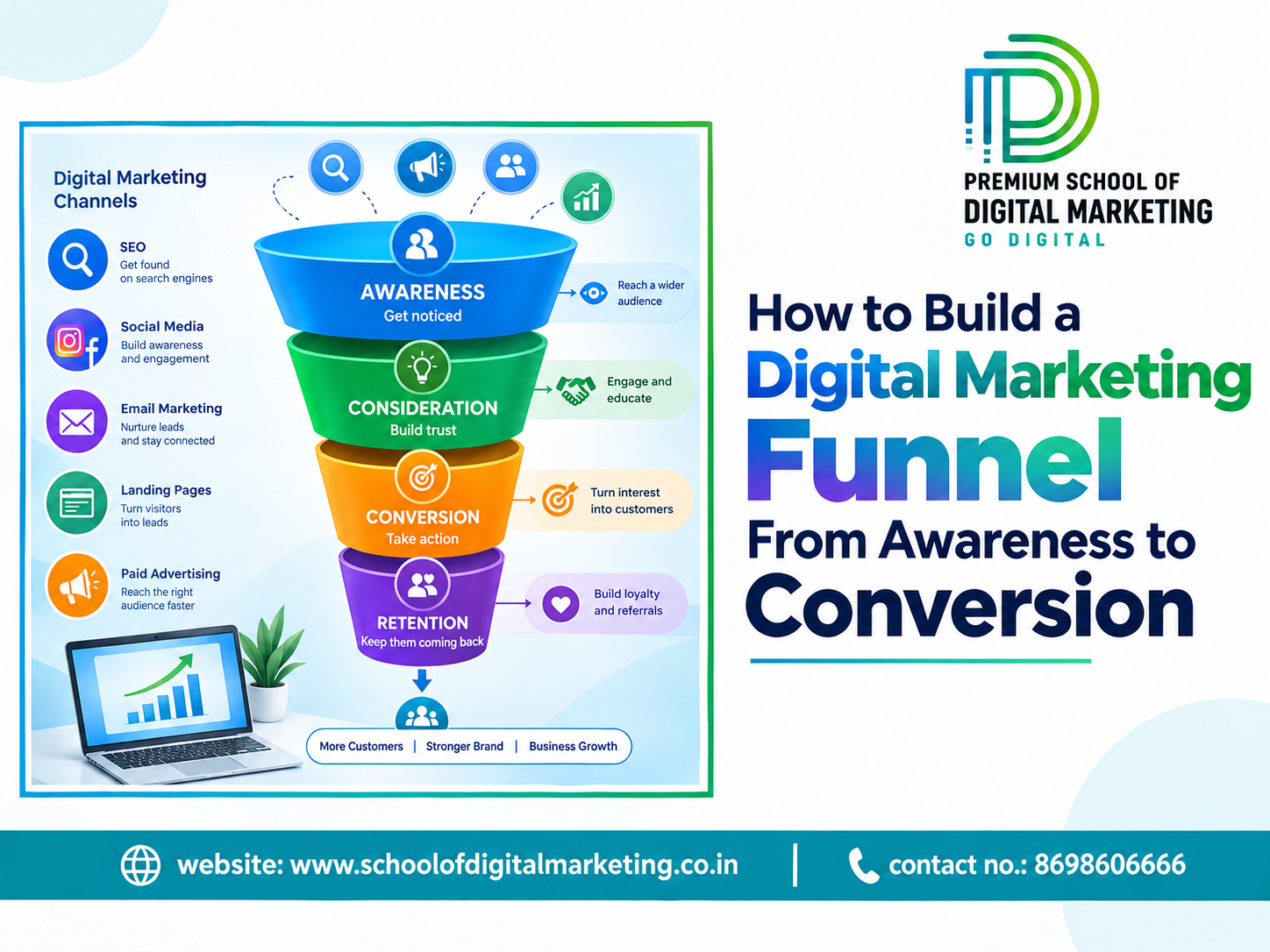
The funnel typically includes four stages: Awareness, Consideration, Conversion, and Retention. Some models also include Interest and Decision as separate stages.
The purpose of a digital marketing funnel is to deliver relevant information at the right time, build trust, reduce purchase hesitation, and help more prospects become customers.
For example, a person searching for a digital marketing course may discover an institute through Google, read its course details, attend a free demo session, compare available programs, and eventually enrol.
Why is a Digital Marketing Funnel Important?
A well-planned funnel connects different marketing activities into a coordinated customer journey instead of treating SEO, social media, paid advertising, and email marketing as separate activities.
Key benefits include:
- Better audience targeting: Match content and advertisements to the needs of potential customers.
- Improved lead generation: Encourage interested visitors to submit enquiries or register for a demo.
- More relevant communication: Share educational content before presenting a sales offer.
- Better marketing measurement: Track how prospects move from website visits to leads and customers.
- Improved budget allocation: Identify which channels contribute to qualified enquiries and sales.
- Stronger customer relationships: Continue engaging customers after their first purchase.
However, a funnel does not guarantee conversions. Results depend on audience relevance, offer quality, pricing, competition, website experience, and the effectiveness of follow-up communication.
What are the Four Main Stages of a Digital Marketing Funnel?
1. Awareness: Help People Discover Your Brand
The awareness stage is the first interaction between a potential customer and your business. At this point, people may be exploring a problem, researching a topic, or discovering a solution for the first time.
Objective: Reach the right audience and attract relevant attention.
Recommended digital marketing channels:
- Search engine optimization (SEO)
- Informational blog content
- Social media marketing
- YouTube videos and short-form videos
- Display advertising
- Educational posts and infographics
Example: A digital marketing institute publishes a blog about career opportunities in digital marketing. A student searching for career guidance discovers the article through Google.
How to measure performance: Organic impressions, website traffic, social media reach, video views, and new visitors.
Practical tip: Focus on answering your audience’s questions instead of promoting your product or service in every post. Helpful content creates an initial connection and gives visitors a reason to explore your brand.
2. Consideration: Build Interest and Trust
At the consideration stage, potential customers know about your brand and want to understand whether your product or service meets their needs.
They may compare providers, examine features, check reviews, read case studies, or look for evidence that your business can deliver value.
Objective: Educate prospects and establish credibility.
Recommended digital marketing tactics:
- Detailed service or course pages
- Comparison articles
- Case studies and testimonials
- Webinars and free demo sessions
- Email newsletters
- Downloadable guides
- Frequently asked questions
Example: After reading a blog about digital marketing careers, a student visits a course page to explore the syllabus, practical assignments, available tools, trainer experience, and placement support.
How to measure performance: Returning visitors, course or service page views, email sign-ups, webinar registrations, and time spent engaging with important content.
Practical tip: Make it easy for visitors to find relevant information. Use clear navigation, useful internal links, transparent course or service details, and genuine customer feedback.
3. Conversion: Turn Interested Prospects Into Customers
The conversion stage is where a prospect completes a desired action. Depending on the business, this could be making a purchase, booking an appointment, requesting a quotation, registering for a course, or submitting a qualified lead form.
Objective: Remove friction and make the next step clear.
Recommended digital marketing tactics:
- Dedicated landing pages
- Clear calls to action (CTAs)
- Short and user-friendly enquiry forms
- Relevant offers and demo sessions
- Retargeting campaigns where appropriate
- Lead follow-up through email or telephone
- Trust signals, including transparent policies and verified testimonials
Example: A student who has reviewed a digital marketing course page clicks “Book a Free Demo,” submits an enquiry, attends the session, and enrols after evaluating the program.
How to measure performance: Enquiries, qualified leads, purchases, cost per lead, conversion rate, and customer acquisition cost.
Practical tip: Match the CTA to the visitor’s readiness. Someone discovering your brand may prefer a free guide, while someone comparing courses may be ready to book a demo or speak with an advisor.
Avoid unnecessary form fields, unclear pricing, broken links, and slow-loading landing pages. These issues can create friction and discourage interested prospects.
4. Retention: Encourage Repeat Business and Referrals
The customer journey does not necessarily end with the first conversion. Existing customers can return for additional purchases, recommend a business, or become long-term advocates.
Objective: Improve customer satisfaction, encourage repeat engagement, and build loyalty.
Recommended digital marketing tactics:
- Email follow-up sequences
- Helpful onboarding content
- Product or service usage guides
- Loyalty programs and relevant offers
- Customer feedback surveys
- Community engagement
- Referral campaigns
Example: After enrolling in a digital marketing course, a learner receives learning resources, project guidance, course updates, and opportunities to explore advanced training.
How to measure performance: Repeat purchases, renewal rates, referrals, customer satisfaction, retention rate, and customer lifetime value.
Practical tip: Make retention communication useful rather than sending frequent promotional messages. Relevant support and consistent service quality help maintain customer relationships.
How to Build a Digital Marketing Funnel Step by Step
Understanding funnel stages is only the beginning. The next step is connecting them into a measurable strategy.
Step 1: Define Your Target Audience
Identify who you want to reach and what they need.
Consider their:
- Age group, location, profession, or business type
- Main problems and motivations
- Search behaviour and preferred platforms
- Budget, concerns, and decision-making process
For example, a course provider may target fresh graduates seeking practical skills, working professionals looking to upgrade their knowledge, and business owners who want to manage their own marketing.
Step 2: Set a Clear Goal for Each Stage
Every stage should have a measurable objective.
| Funnel stage | Example goal | Key metric |
|---|---|---|
| Awareness | Attract relevant visitors | Organic clicks or reach |
| Consideration | Generate interest | Course page views or registrations |
| Conversion | Generate enrolments or sales | Conversion rate |
| Retention | Encourage continued engagement | Repeat purchases or referrals |
Choose metrics that reflect actual business goals. Traffic alone does not establish whether a campaign generates profitable customers.
Step 3: Map the Customer Journey
Identify the steps a prospect is likely to take before converting.
For example:
Google search → Informational blog → Course page → Free demo registration → Follow-up communication → Enrolment.
At each step, ask three questions: What does the prospect need to know? What might prevent them from moving forward? What is the most useful next action?
This process helps identify missing content, confusing navigation, and opportunities to improve the customer experience.
Step 4: Create Content for Every Funnel Stage
One piece of content cannot address every audience need.
Use educational blogs, videos, and social posts for awareness; detailed guides, case studies, and comparisons for consideration; and demo sessions, consultations, product pages, and clear offers for conversion.
For retention, provide onboarding material, useful updates, and customer support resources.
A consistent content strategy helps prospects move naturally from learning about a problem to evaluating and choosing a solution.
Step 5: Select the Right Marketing Channels
Choose channels according to your audience, objectives, and resources.
- SEO: Attract people actively searching for relevant information or services.
- Social media: Build awareness, engage audiences, and distribute content.
- Paid advertising: Reach selected audiences and test specific offers.
- Email marketing: Nurture leads and share relevant information over time.
- Landing pages: Present a focused message and guide visitors towards a desired action.
- Analytics tools: Understand performance and identify opportunities for improvement.
You do not need to use every channel immediately. Start with the channels most likely to reach your audience, then expand based on performance.
Step 6: Set Up Lead Capture and Follow-Up
If your goal is lead generation, make sure interested visitors have a simple way to contact you.
Use relevant forms, demo registrations, enquiry buttons, or consultation bookings. Explain what happens after someone submits their details, and follow up promptly with useful information.
Where appropriate, use a CRM or marketing automation platform to organise leads, record interactions, and send relevant communications. Collect personal information transparently and follow applicable privacy requirements.
Step 7: Measure, Test, and Optimise
Review funnel performance regularly to understand where prospects drop off.
For example, high website traffic combined with very few enquiries may indicate that visitors are not finding the right information, the offer is unclear, or the CTA is difficult to locate.
Test one meaningful change at a time, such as a new headline, a shorter form, a different CTA, or a more relevant landing page. Compare results over a suitable period before deciding whether the change improved performance.
Want to master AI-powered Digital PR?
Join our FREE Digital Marketing Demo and learn how to build authority, earn quality backlinks, and grow your brand using AI-driven strategies.
Practical Example: A Digital Marketing Funnel for an Institute
Consider how a digital marketing institute can guide a prospective student from discovery to enrolment.
| Stage | Marketing activity | Example CTA |
|---|---|---|
| Awareness | SEO blog about digital marketing careers | Read the guide |
| Consideration | Course syllabus, student projects, and trainer details | Explore the course |
| Conversion | Free demo session and counselling | Book a free demo |
| Retention | Learning resources, project support, and relevant advanced-course updates | Explore learning resources |
The funnel should connect each activity through relevant internal links, consistent messaging, and timely follow-up.
For instance, the awareness-stage blog can link to a related course page. That page can explain the syllabus and practical training, while a clear demo CTA gives interested visitors a low-friction next step.
This approach supports both organic visibility and lead generation without making every interaction feel like a sales pitch.
Essential Tools for Managing a Digital Marketing Funnel
The right tools depend on your business model and budget. Useful options include:
- Google Analytics 4 (GA4): Analyse website activity, key events, and conversion journeys.
- Google Search Console (GSC): Monitor organic search clicks, impressions, queries, and indexing.
- Google Tag Manager: Manage supported website tracking tags and events.
- CRM platforms: Organise contacts, track lead stages, and manage follow-ups.
- Email marketing platforms: Send newsletters and automated communication.
- Advertising platforms: Measure campaign performance and manage paid acquisition.
- Landing page and form tools: Build focused pages and capture enquiries.
Configure important events correctly and check that analytics data is reliable before using it to make budget decisions.
Common Digital Marketing Funnel Mistakes to Avoid
Even a well-designed funnel can underperform when important details are overlooked.
- Focusing only on awareness: Website traffic is useful, but visitors also need relevant information and clear next steps.
- Using the same message everywhere: First-time visitors and purchase-ready prospects have different needs.
- Ignoring mobile users: Forms, navigation, and landing pages should work well on smaller screens.
- Making conversion difficult: Unnecessary fields and unclear CTAs can create friction.
- Neglecting lead follow-up: Interested prospects may lose momentum if enquiries receive no timely response.
- Tracking vanity metrics alone: Evaluate qualified leads and business outcomes, not just views or likes.
- Ignoring retention: Customer support and continued engagement can be important parts of long-term growth.
Keep learning, keep growing!
Check out our latest blogs On Generative AI in Digital Marketing
How Learning Digital Marketing Helps You Build Better Funnels
Building an effective digital marketing funnel requires more than publishing content or running advertisements. It involves understanding customer behaviour, SEO, paid campaigns, content marketing, landing pages, analytics, and conversion optimisation.
Students and professionals who develop these skills can better understand how individual marketing activities contribute to business results.
If you want to strengthen your practical knowledge, explore the programs offered by the School of Digital Marketing and learn how different digital marketing channels work together.
Whether you are starting your career or upgrading your existing skills, focus on practical projects, campaign measurement, and real-world customer journeys to build a stronger foundation.
Conclusion
A successful digital marketing funnel connects awareness, consideration, conversion, and retention into one customer-focused strategy. It helps businesses deliver relevant information, build trust, guide prospects towards meaningful actions, and measure what works.
Start by defining your audience and goals, mapping the customer journey, creating stage-specific content, choosing suitable channels, and tracking key metrics. Then improve the funnel using real performance data.
The goal is not simply to attract more visitors. It is to help the right people find your business, understand its value, and take the next step with confidence.
Frequently asked questions (FAQs)
1. What is a digital marketing funnel?
A digital marketing funnel is a framework that guides potential customers from discovering a brand to considering its products or services, completing a conversion, and potentially becoming repeat customers.
2. What are the four stages of a digital marketing funnel?
The four common stages are Awareness, Consideration, Conversion, and Retention. Awareness attracts attention, consideration builds trust, conversion encourages action, and retention supports long-term customer relationships.
3. How do you build a digital marketing funnel?
Start by identifying your target audience and business goals. Map the customer journey, create content for each stage, select suitable marketing channels, set up lead capture and follow-up, and measure performance using analytics.
4. Which digital marketing channels are best for a funnel?
SEO, content marketing, social media, paid advertising, email marketing, and landing pages can all support a funnel. The best combination depends on your target audience, budget, product, and conversion goals.
5. How does SEO help a digital marketing funnel?
SEO attracts people searching for relevant information, products, and services. Helpful blog posts can introduce a brand, while service pages, comparison content, and relevant internal links can guide visitors towards enquiries or purchases.
6. What is the difference between a marketing funnel and a sales funnel?
A marketing funnel generally focuses on attracting audiences, building interest, and generating leads. A sales funnel focuses more closely on evaluating prospects, handling objections, and converting qualified leads into customers. In practice, the two funnels often overlap.
7. Which tools can be used to measure a digital marketing funnel?
Google Analytics 4, Google Search Console, advertising dashboards, CRM platforms, and email marketing tools can help measure different stages. Configure appropriate events and conversion tracking to understand how users move through the funnel.
8. How long does it take to see results from a digital marketing funnel?
The timeline varies by industry, audience, budget, competition, and channel. Paid campaigns may generate initial leads relatively quickly, while SEO typically requires sustained work. Reliable conversion and revenue insights may take additional time and sufficient data.
Ready to become an Expert Digital Marketer?
Discover practical AI tools, Digital PR strategies, and SEO techniques in our FREE live demo session conducted by industry experts.