
Table of Contents
When searching for the best digital marketing institute in Pune, students and professionals are increasingly looking for training that covers not only traditional SEO but also emerging AI-powered search technologies. Search behaviour is evolving. People still use Google to discover websites, but they also ask conversational questions, explore AI-generated summaries, and use tools such as ChatGPT to research products, services, and solutions.
For digital marketers, this raises an important question: Is traditional SEO enough, or should businesses also focus on Generative Engine Optimization (GEO) and Answer Engine Optimization (AEO)?
Understanding SEO vs GEO vs AEO can help students, freshers, digital marketers, and business owners adapt their content strategies to changing search experiences. Whether you are exploring a digital marketing institute in Pune, Mumbai, Nashik, or Nagpur, learning these approaches can help you build a stronger foundation in modern digital marketing.
What is SEO (Search Engine Optimization)?
Search Engine Optimization (SEO) is the practice of improving a website’s visibility in unpaid search results. It involves helping search engines discover, crawl, understand, and evaluate website content while providing a useful experience for visitors.
Traditional SEO focuses on several important areas:
- On-page SEO: Optimizing titles, headings, content, URLs, images, and internal links.
- Technical SEO: Improving crawlability, indexability, mobile usability, page performance, and site architecture.
- Off-page SEO: Earning relevant backlinks, mentions, and other signals that support a website’s authority.
- Local SEO: Improving visibility for location-based searches through an eligible Google Business Profile, local landing pages, reviews, and consistent business information.
- Content strategy: Creating useful pages that satisfy the search intent behind relevant queries.
Example of SEO in action
Imagine a student searches for “digital marketing course in Pune.” An institute can improve its chances of appearing in relevant organic results by creating a helpful course page, explaining its curriculum, providing accurate location and contact details, improving mobile usability, and earning relevant references from trustworthy websites.
SEO does not guarantee a particular ranking. Search visibility depends on multiple factors, including relevance, competition, technical accessibility, and search-engine systems.
What is AEO (Answer Engine Optimization)?
Answer Engine Optimization (AEO) is the practice of structuring and improving content so that answer-oriented systems can understand it and potentially use it to respond to specific questions.
These experiences can include featured snippets, voice assistants, direct-answer interfaces, and other search experiences that surface an answer rather than requiring users to open several pages.
AEO is particularly relevant to question-based searches such as:
- What is technical SEO?
- How does keyword research work?
- What is the difference between SEO and GEO?
- Which digital marketing skills should beginners learn?
How to optimize content for AEO
1. Answer questions directly. Place a concise, accurate answer near the beginning of the relevant section.
2. Use question-based headings. Headings such as “What Is GEO?” and “How Does AEO Work?” make the content easier to navigate.
3. Add structured information. Use appropriate lists, tables, step-by-step instructions, and FAQs where they genuinely help readers.
4. Support answers with context. A short definition is useful, but readers also need examples, explanations, and evidence.
5. Keep technical SEO strong. Important content should be accessible to search engines, with appropriate indexing controls and clear page structure.
For example, an article explaining keyword research could begin with a direct definition, followed by a simple process, a practical example, recommended tools, and common mistakes.
Clear formatting can improve usability and machine understanding, but it does not guarantee a featured snippet, voice-search answer, or AI citation.
Want to Understand How Answer Engines Find and Present Information?
Learn how to create clear, helpful content that answers user questions and supports modern search experiences. Explore practical digital marketing learning opportunities to strengthen your SEO and content strategy.
Discover Digital Marketing Learning Opportunities
What is GEO (Generative Engine Optimization)?
Generative Engine Optimization (GEO) refers to improving how a brand, website, or its content may be discovered, interpreted, referenced, or represented in generative AI responses.
Generative search experiences can combine information from multiple sources to produce a conversational response. Depending on the platform and query, they may also provide links or citations to supporting sources.
GEO extends the visibility conversation beyond traditional blue-link rankings. Marketers also need to consider whether their brand is accurately represented in relevant AI-generated answers.
How GEO works in practice
Suppose someone asks an AI assistant:
“Which digital marketing institute should a beginner consider in Pune?”
A useful website should make its offering easy to understand. Its course pages might clearly explain the curriculum, practical projects, faculty experience, delivery format, location, and support offered to learners.
These details help people assess the institute and give information systems clearer source material to interpret. However, publishing such content does not guarantee that an AI system will mention or recommend the institute.
GEO best practices
- Publish original, accurate content that demonstrates relevant expertise.
- Explain concepts clearly and support factual claims with credible sources.
- Include meaningful examples, comparisons, and practical experience where available.
- Maintain consistent brand information across the website and legitimate third-party profiles.
- Use descriptive headings, clear definitions, and useful supporting details.
- Strengthen technical SEO so that important pages can be discovered and accessed.
- Monitor AI referrals, brand mentions, citations, and the accuracy of brand descriptions where measurable.
Avoid publishing unsupported claims simply to make a page sound authoritative. Trustworthy information is more useful than content written only to influence AI systems.
Want to Learn How AI Can Recommend Your Brand?
Join our Free Demo Session and discover practical strategies to improve your brand’s visibility across ChatGPT and AI-powered search experiences.
Learn how useful content, search optimization, and brand credibility can support your digital visibility strategy.
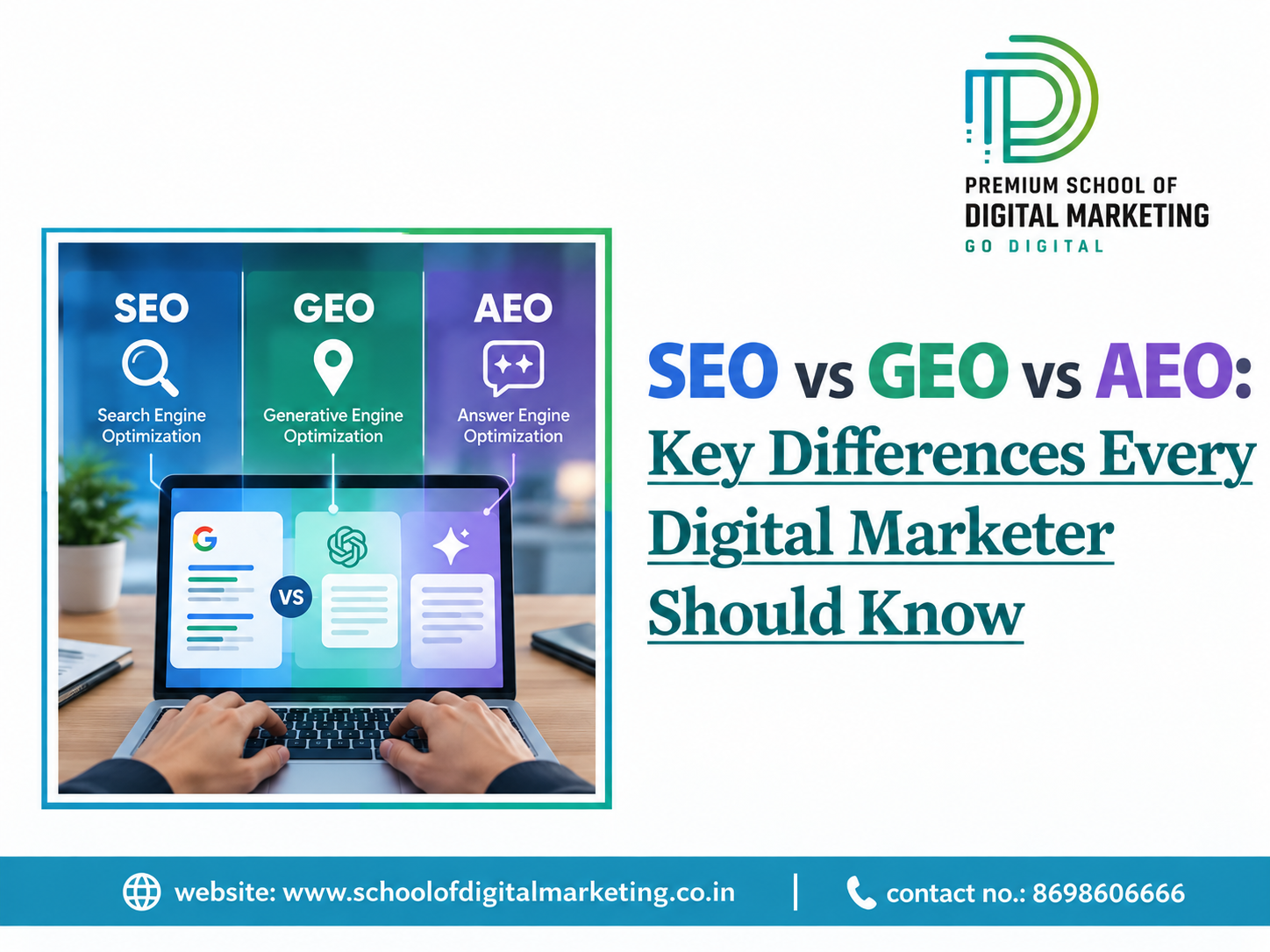
SEO vs GEO vs AEO: Key Differences
| Comparison factor | SEO | AEO | GEO |
|---|---|---|---|
| Main objective | Improve organic search visibility | Make content suitable for direct answers | Improve visibility and representation in generative AI responses |
| Typical experiences | Organic search listings | Featured answers and answer-oriented interfaces | AI-generated summaries and conversational responses |
| Content approach | Relevant, comprehensive, search-intent-led content | Direct answers, clear questions and structured explanations | Credible, contextual, distinctive and easy-to-interpret information |
| Technical foundation | Crawlability, indexability, performance and site structure | Accessible content and clear information structure | Accessible, understandable and trustworthy source content |
| Key measurement areas | Organic clicks, impressions, rankings and conversions | Relevant answer appearances where measurable, clicks and engagement | AI referrals, source citations, brand mentions and referral conversions where measurable |
| Main limitation | Rankings and traffic are not guaranteed | Answer selection is not guaranteed | AI citations and brand mentions can vary and may be difficult to measure |
The three approaches are not separate replacements for one another. SEO provides an important foundation, while AEO and GEO emphasize additional ways content can be understood and surfaced across evolving discovery experiences.
Want to Learn More About the Latest Digital Marketing Trends?
Explore how SEO, AI-powered search, content marketing, and analytics are shaping the digital marketing industry. Build your understanding of modern marketing strategies with the School of Digital Marketing.
Explore Digital Marketing Courses
Can SEO, GEO and AEO Work Together?
Yes. An integrated strategy can address traditional search results, direct-answer experiences, and generative AI discovery without maintaining three completely separate content strategies.
Consider a digital marketing institute publishing an article about technical SEO.
For SEO: Research the search intent, write a useful article, optimize the title and headings, improve internal linking, and ensure the page can be indexed.
For AEO: Include a clear definition, answer common beginner questions, and present technical steps in a logical sequence.
For GEO: Add original examples, explain trade-offs, reference authoritative documentation, and clearly identify the source of any experience-based insights.
One well-planned article can support all three objectives. The goal is not to repeat keywords or create separate pages for every acronym. It is to make information genuinely useful, discoverable, and easy to interpret.
Practical Tools for SEO, AEO and GEO
The following tools can support different parts of an integrated strategy. Their capabilities vary, and no tool guarantees visibility.
| Tool | Practical use |
|---|---|
| Google Search Console | Monitor search impressions, clicks, queries, indexing and page performance |
| Google Analytics 4 | Measure website engagement, referral traffic and conversions |
| Google Trends | Explore changes in interest and compare topic patterns |
| Semrush or Ahrefs | Research keywords, competitors, backlinks and organic visibility |
| Screaming Frog SEO Spider | Audit links, metadata, headings, status codes and technical issues |
| PageSpeed Insights | Evaluate page performance and receive improvement recommendations |
| Schema Markup Validator | Check the syntax and structure of supported schema markup |
| Google Rich Results Test | Test eligibility for supported Google rich-result features |
| ChatGPT and other AI assistants | Brainstorm questions, organize research and test how clearly content answers user needs |
AI tools can assist with research and drafting, but human review remains essential for accuracy, originality, context, and factual claims.
Take Your Digital Marketing Skills Further
Learn how to combine SEO, keyword research, content optimization, analytics, and AI tools to develop practical digital marketing skills. Explore learning opportunities designed to help you understand and apply modern marketing techniques.
Explore the School of Digital Marketing
A Practical 30-Day Implementation Plan
Businesses and digital marketers can start with a focused plan rather than attempting to optimize every page simultaneously.
Week 1: Audit and research
- Review important pages in Google Search Console and GA4.
- Identify high-value queries, content gaps, technical issues, and conversion opportunities.
- Select three to five important topics based on audience needs and business relevance.
Week 2: Improve content
- Refresh one or two priority pages with clear answers and descriptive headings.
- Add relevant examples, trustworthy references, and useful internal links.
- Review titles, meta descriptions, image alt text, and page structure.
Week 3: Strengthen credibility and accessibility
- Check indexing, broken links, mobile usability, and page performance.
- Add appropriate structured data only where it accurately represents the page.
- Review author information, factual claims, and business details.
Week 4: Measure and refine
- Compare organic clicks, impressions, engagement, and enquiries against a baseline.
- Review AI referral traffic and source mentions where reliable data is available.
- Test relevant user questions across selected AI platforms, recording the date, prompt, and observed sources. Treat these checks as snapshots, not definitive rankings.
- Prioritize improvements based on evidence rather than isolated AI-generated answers.
Thirty days is a useful starting period for implementation, not a promised ranking or traffic-growth timeline. Results depend on the website, competition, content quality, and the changes made.
What This Means for Aspiring Digital Marketers
SEO, GEO and AEO are becoming useful concepts for understanding modern search visibility. For students and professionals, the practical opportunity is to combine foundational SEO knowledge with content strategy, analytics, technical understanding, and responsible AI-assisted workflows.
Someone comparing a digital marketing institute in Pune, Mumbai, Nashik, or Nagpur should look beyond course titles and examine whether the curriculum includes practical SEO audits, keyword research, Google Search Console, GA4, structured data, content optimization, and measurement.
The same principle applies to business owners: select training and tools based on real business needs, practical experience, and the ability to evaluate results.
Conclusion
SEO, AEO and GEO address overlapping aspects of online discovery. SEO helps make content discoverable in search engines, AEO emphasizes clear and useful answers, and GEO focuses on how brands and sources may appear in generative AI responses.
The most sustainable strategy is to publish helpful, credible content, maintain strong technical foundations, answer genuine customer questions, and measure the outcomes that matter to your audience and business.
Want to build practical digital marketing skills? Explore the programs offered by the School of Digital Marketing, review the curriculum and hands-on learning opportunities, and enquire about the course that best fits your goals.
Frequently Asked Questions
1. What is the difference between SEO, GEO and AEO?
SEO focuses on organic search visibility, AEO focuses on making content useful for direct-answer experiences, and GEO focuses on how brands and content may be represented in generative AI responses. All three benefit from relevant, accessible, trustworthy information.
2. Is GEO replacing SEO?
No. GEO is better treated as a complementary approach. Search engines and AI experiences still need to discover and interpret information, so technical accessibility, relevant content, and credibility remain important.
3. Is AEO the same as GEO?
No. AEO emphasizes providing clear answers to specific questions, while GEO emphasizes visibility and representation within generative AI responses. Their techniques overlap, and neither guarantees that content will be selected.
4. How can I optimize my website for AI search?
Publish accurate, useful content; use descriptive headings; answer important questions directly; maintain technical SEO; provide credible references; and ensure your brand information is consistent. Measure AI referral traffic and citations where reliable data is available.
5. Which tools are useful for SEO, AEO and GEO?
Google Search Console, GA4, Google Trends, Semrush, Ahrefs, Screaming Frog, and PageSpeed Insights can support research, technical audits, and performance measurement. AI assistants can help with brainstorming and content review, but their outputs require verification.
6. Does schema markup guarantee AI citations or featured snippets?
No. Structured data helps eligible systems interpret specific information, but it does not guarantee rankings, featured snippets, AI citations, or rich results. Markup must accurately reflect visible page content and follow the relevant guidelines.
7. What skills should a digital marketer learn for AI-driven search?
Start with keyword research, search intent, on-page and technical SEO, content writing, Google Search Console, GA4, structured data, and conversion measurement. Then learn how to evaluate AI-generated content, research sources, and measure emerging discovery channels.
8. How do I choose the best digital marketing institute in Pune?
Compare the curriculum, practical assignments, trainer experience, analytics training, course format, student support, and verifiable placement information. Look for opportunities to work on real-world projects rather than relying on promotional claims alone.
Looking for Digital Marketing Training in Your City?
Whether you are a student, fresher, working professional, or business owner, explore digital marketing training options and find a program that aligns with your goals.
- Digital Marketing Institute in Pune
- Digital Marketing Institute in Mumbai
- Digital Marketing Institute in Nashik
- Digital Marketing Institute in Nagpur
Review the available curriculum, practical learning opportunities, and course details before choosing a program.