
Table of Contents
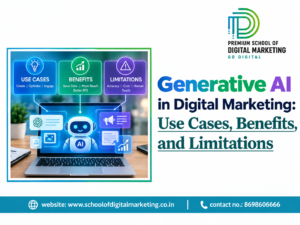
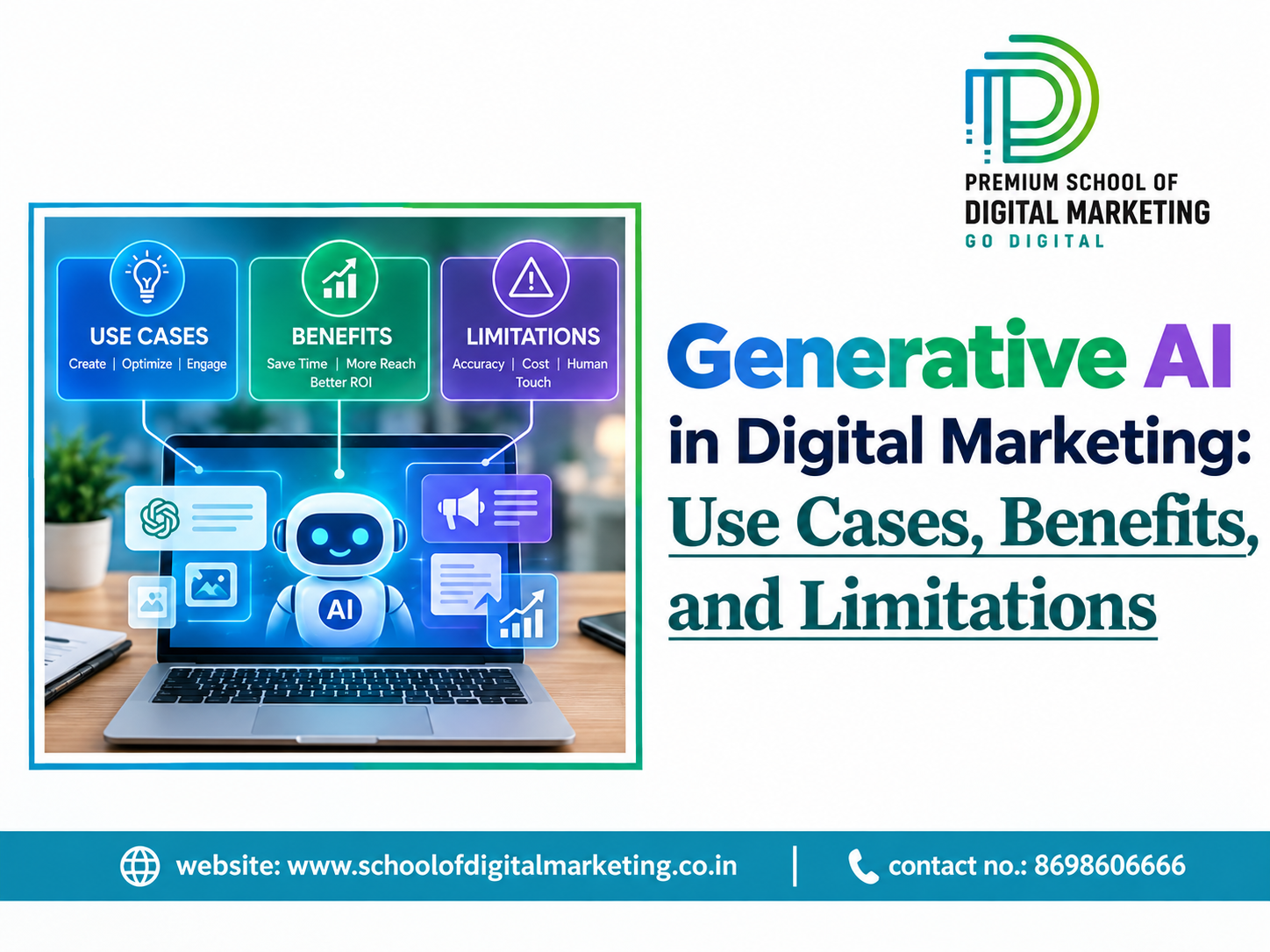
Generative AI is changing how digital marketers create content, analyse data, manage campaigns, and communicate with customers. From generating blog ideas to creating social media posts and supporting SEO research, AI tools are helping marketing teams work more efficiently.
For students and professionals exploring a digital marketing course in Pune, understanding Generative AI is becoming an important part of developing practical, industry-relevant skills. However, AI is not a replacement for marketing strategy, creativity, or human judgement. Its effectiveness depends on how marketers use it.
In this guide, we’ll explore what Generative AI means, its major applications in digital marketing, its benefits and limitations, and how marketers can use it responsibly.
What is Generative AI in Digital Marketing?
Generative AI refers to artificial intelligence technology that can generate new content, including text, images, videos, audio, and ideas, based on user instructions and the information available to the model.
In digital marketing, it can assist with:
- Creating blog outlines, social media captions, and email drafts.
- Generating keyword ideas and content briefs.
- Developing advertising copy variations.
- Supporting customer service through conversational chatbots.
- Summarising campaign performance and customer feedback.
- Producing visual concepts for marketing campaigns.
Tools such as ChatGPT, Google Gemini, Claude, Canva AI, and Adobe Firefly can support different marketing activities. The right tool depends on the task, budget, workflow, and data privacy requirements.
To understand how AI fits into a broader marketing strategy, read our related guide on AI Prompt Engineering for Marketing
1. Content Creation and Content Marketing
Content marketing requires a steady flow of useful, relevant, and engaging information. Generative AI can help marketers plan and draft content more quickly.
How marketers can use it
- Generate blog topic ideas based on audience questions.
- Create article outlines and first drafts.
- Repurpose blogs into LinkedIn posts, email newsletters, and social media captions.
- Suggest headlines, introductions, and calls to action.
- Develop content calendars for different platforms.
For example, a digital marketing institute can use AI to brainstorm blog topics about SEO, paid advertising, social media marketing, and emerging technologies. A marketer must still verify facts, add practical examples, and ensure that the final content reflects the brand’s experience and expertise.
AI-generated content should not be published without review. Helpful content needs originality, accuracy, a clear purpose, and value for the reader.
read our related guide on Why Human Creativity Still Matters in the Age of AI
2. SEO, AEO, and GEO
Generative AI can support several parts of search optimisation, including keyword research, search-intent analysis, content briefs, FAQ ideas, title suggestions, and content gap analysis.
For example, an SEO professional can use AI to organise search queries into topic clusters, identify questions that a page should answer, and create a draft outline before writing the content.
AI can also support the planning of content for traditional search engines and AI-powered discovery experiences. However, using AI does not automatically improve rankings or guarantee that a brand will be mentioned in AI-generated answers.
Effective optimisation still requires technically accessible pages, useful content, clear structure, relevant internal links, and trustworthy information.
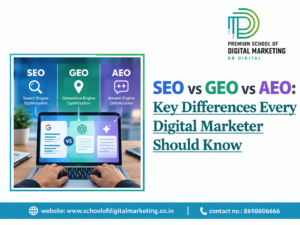
Marketers interested in how search is evolving should also read SEO vs GEO vs AEO. This can help readers understand how traditional SEO connects with Answer Engine Optimisation and Generative Engine Optimisation.
For learners considering a digital marketing course in Mumbai, understanding how AI supports keyword research and content planning can be useful when developing practical SEO skills.
3. Social Media Marketing
Social media marketers need to create platform-specific content consistently. Generative AI can help with ideation, caption writing, content repurposing, and creative variations.
Practical applications
- Brainstorm Instagram and LinkedIn post ideas.
- Draft captions in different tones.
- Turn a long article into short posts.
- Suggest content themes for a monthly calendar.
- Generate concepts for reels, carousels, and promotional campaigns.
- Adapt messaging for different audience segments.
For example, a single blog about the benefits of digital marketing training could be converted into a LinkedIn educational post, an Instagram carousel, and a short video script.
The final content should still be checked for brand voice, platform suitability, factual accuracy, and originality. AI-generated visuals and copy may also require review for misleading claims, licensing restrictions, and brand consistency.
4. Email Marketing and Personalisation
Email marketing involves delivering relevant messages to subscribers at the right stage of their customer journey. Generative AI can assist with drafting subject lines, writing email variations, and adapting messages for different audiences.
Marketers can use it to:
- Draft welcome emails and follow-up messages.
- Suggest subject lines for testing.
- Create promotional email variations.
- Summarise customer feedback.
- Adapt messages for different customer segments.
AI can help generate several versions of an email, but performance should be evaluated through actual campaign data. Open rates, clicks, conversions, unsubscribes, and other relevant metrics provide stronger evidence than AI predictions alone.
Personalisation must also respect consent and data privacy. Marketers should avoid entering confidential customer information into AI tools without appropriate safeguards.
5. Paid Advertising and Campaign Optimisation
Generative AI can support Google Ads, Meta Ads, and other paid marketing campaigns by producing draft headlines, descriptions, primary text, and creative concepts.
For example, a marketer promoting a training programme can test different messaging angles, such as career development, practical learning, or skill enhancement.
AI may also help summarise performance reports and suggest questions to investigate, such as which audience segments or creatives are generating more conversions.
However, campaign decisions should be based on real performance data, campaign objectives, conversion tracking, and budget constraints. AI-generated copy is not guaranteed to perform better, and advertising platforms have their own policies regarding claims and prohibited content.
6. Chatbots and Customer Support
AI-powered chatbots can help businesses respond to common questions, guide users towards relevant information, and support lead-generation workflows.
Potential use cases include:
- Answering frequently asked questions.
- Explaining services or course options.
- Guiding users to enquiry forms.
- Collecting basic lead details with appropriate consent.
- Directing complex queries to a human representative.
For instance, a training institute could use a chatbot to help visitors find information about course modules, learning formats, and enquiry procedures.
Chatbots should be configured with accurate, approved information. They must not invent fees, placement guarantees, eligibility criteria, or other important details. Human support should remain available for complex or sensitive queries.
7. Visual Content and Creative Production
AI-powered design tools can help marketers explore creative concepts and produce initial visual assets for campaigns.
Applications include:
- Brainstorming campaign themes.
- Generating image concepts.
- Creating social media design drafts.
- Adapting creative ideas to different formats.
- Developing visual variations for testing.
Tools such as Canva AI and Adobe Firefly can support creative workflows, depending on the features available in the relevant plan.
AI visuals should be checked for visual errors, brand consistency, accessibility, and usage rights. Marketers should also review the terms of the tool they use before including generated assets in commercial campaigns.
Benefits of Generative AI in Digital Marketing
When used thoughtfully, Generative AI can provide several benefits.
1. Faster content production
AI can speed up brainstorming, outlining, and first-draft creation. This gives marketers more time to focus on editing, research, and strategy.
2. More ideas to test
It can generate alternative headlines, content angles, captions, and advertising messages. Marketers can then test suitable variations against campaign objectives.
3. Support for data interpretation
AI can summarise reports, explain trends, and suggest questions for further analysis. Results must still be checked against the original data.
4. Improved workflow efficiency
Routine drafting and repurposing tasks can be streamlined, helping teams manage recurring marketing activities more efficiently.
5. Support for learning
Beginners can use AI to understand marketing concepts, practise writing, explore campaign structures, and develop initial ideas. They should verify answers rather than treating AI output as authoritative.
For anyone researching a digital marketing course in Nashik, learning to combine AI tools with practical SEO, analytics, advertising, and content skills can help build a more complete marketing workflow.
Limitations and Risks of Generative AI
Despite its benefits, Generative AI has limitations that marketers need to understand.
1. Inaccurate information
AI may generate incorrect facts, statistics, citations, or explanations. Important claims should be verified using reliable sources before publication.
2. Generic content
Prompts that lack context often produce repetitive or predictable content. Original research, customer insights, industry knowledge, and real examples help make content more useful.
3. Limited human understanding
AI can imitate a tone, but it may not fully understand a customer’s emotions, cultural context, or a brand’s unique positioning.
4. Privacy and security concerns
Uploading personal information, confidential campaign data, or customer records may create privacy risks. Organisations should follow applicable laws and their internal data-handling policies.
5. Copyright and usage questions
The rights and permitted uses of AI-generated content can depend on the tool, its terms, and applicable law. Marketers should review licensing requirements before using assets commercially.
6. Bias and unfair assumptions
AI output may reflect biases or make inappropriate assumptions about audiences. Campaign messages, targeting choices, and generated visuals should be reviewed carefully.
7. Overdependence on automation
Relying entirely on AI can weaken originality and lead to poor decisions. Human oversight is essential for strategy, quality control, ethical judgement, and accountability.
How to Use Generative AI Effectively
A practical workflow combines AI assistance with human expertise.
- Define the objective: Identify whether the task is content creation, SEO research, advertising, reporting, or customer support.
- Provide relevant context: Explain the audience, brand voice, campaign goal, platform, and output requirements.
- Generate a draft: Use an appropriate tool to create ideas or an initial version.
- Verify the information: Check facts, statistics, links, and claims against reliable sources.
- Add human value: Include experience, original insights, examples, and brand-specific knowledge.
- Review compliance: Check privacy, copyright, platform policies, and accessibility.
- Measure the result: Use real performance data to determine what worked and what needs improvement.
Students and professionals looking for a digital marketing course in Nagpur can use this workflow as a practical learning framework while developing skills in SEO, social media, paid campaigns, analytics, and content marketing.
The Future of Generative AI in Digital Marketing
Generative AI is likely to remain an important part of digital marketing workflows. Marketers will continue exploring its use in content planning, creative production, campaign analysis, personalisation, and AI-powered search discovery.
However, success will not depend simply on knowing how to generate content. Marketers will need to understand customer behaviour, interpret data, develop strong strategies, and evaluate AI output critically.
For people considering a digital marketing course in Pune or exploring training options through a digital marketing course in Mumbai, a useful learning path is to combine AI literacy with practical skills in SEO, social media, paid advertising, analytics, and content strategy.
The same principle applies to learners in Nashik and Nagpur: focus on developing real marketing skills and using AI as a supporting tool, rather than relying on automation alone.
Conclusion
Generative AI is changing the way digital marketing tasks are planned and executed. It can help with content creation, SEO research, social media, email marketing, advertising, customer support, and creative production.
At the same time, it can produce inaccurate or generic information and raise concerns around privacy, bias, and content rights. The most effective approach is to combine AI tools with human judgement, verified information, original thinking, and measurable marketing objectives.
To explore training options, visit the School of Digital Marketing website. You can also learn more about the digital marketing courses in Nagpur.
Choose a learning path that helps you understand not only how to use AI tools, but also how to plan, execute, measure, and improve digital marketing campaigns.
Frequently Asked Questions
1. What is Generative AI in digital marketing?
Generative AI in digital marketing refers to the use of artificial intelligence tools to create content, generate campaign ideas, support SEO research, personalise marketing messages, and improve workflow efficiency.
2. How is Generative AI used in digital marketing?
Generative AI is used for blog writing, social media content creation, email marketing, keyword research, advertising copy, chatbot responses, image generation, and campaign data analysis.
3. What are the benefits of using Generative AI in digital marketing?
The main benefits include faster content production, improved brainstorming, workflow automation, support for personalisation, and assistance with analysing marketing data. Human review is still necessary to ensure accuracy and quality.
4. What are the limitations of Generative AI in digital marketing?
Generative AI can produce inaccurate information, generic content, biased responses, and misleading claims. It may also raise concerns about privacy, copyright, and data security.
5. Can Generative AI replace digital marketers?
No. Generative AI can assist with repetitive tasks and content creation, but digital marketers are still needed for strategy, creativity, audience understanding, campaign management, quality control, and performance evaluation.
6. Which Generative AI tools are useful for digital marketing?
Popular tools include ChatGPT and Google Gemini for content ideas and research assistance, Canva AI and Adobe Firefly for creative work, and other AI-enabled platforms for campaign planning and analysis. The best choice depends on the task and requirements.
7. How can beginners learn Generative AI for digital marketing?
Beginners can start by practising prompt writing, creating social media content, developing blog outlines, exploring SEO applications, and analysing sample campaign data. A practical digital marketing course in Pune, Mumbai, Nashik, or Nagpur can also help learners build broader marketing skills alongside AI knowledge.
8. Will Generative AI improve SEO rankings?
Generative AI can support keyword research, content planning, and optimisation, but using AI does not guarantee higher rankings. SEO performance depends on content usefulness, search intent, technical accessibility, website quality, and other relevant ranking factors.